Table of Contents
Introduction
Why Preventive Maintenance Matters
Monthly Maintenance Tasks
Quarterly Maintenance Tasks
Semi-Annual Maintenance Tasks
Annual Maintenance Tasks
Bearing Lubrication Guidelines
Building a Maintenance Log
Summary
Frequently Asked Questions
References
1.Introduction
Blower fans operate in demanding environments, moving air continuously through HVAC ducts, server rooms, industrial exhaust stacks, and cleanroom systems. Like any mechanical equipment, they degrade over time. Filters clog, bearings wear, belts stretch, and electrical connections loosen. Without a structured maintenance schedule, these minor issues compound into catastrophic failures that cause downtime, equipment damage, and expensive emergency repairs [4].
This article provides a complete preventive maintenance schedule for blower fans, broken down by interval: monthly, quarterly, semi-annual, and annual. Each section lists specific tasks, explains why they matter, and references the industry standards that define them. Whether you manage a single rooftop unit or a facility with hundreds of blowers, this schedule will help you extend equipment life and reduce unplanned downtime [1].
2.Why Preventive Maintenance Matters

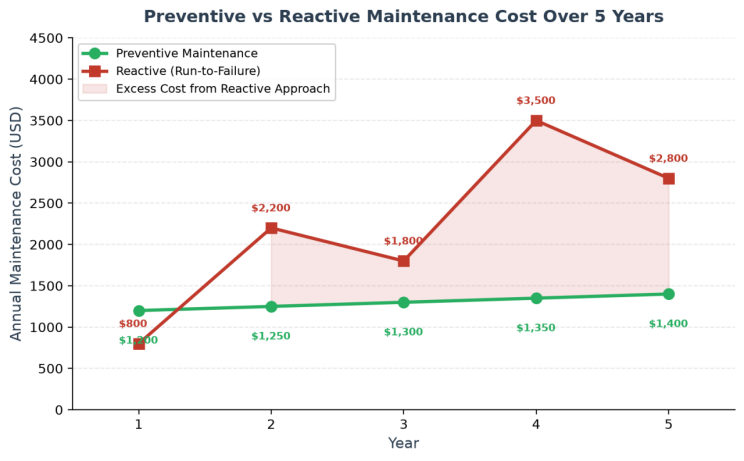
Figure 1: Preventive vs reactive maintenance cost over 5 years. While preventive maintenance has a consistent annual cost, reactive maintenance leads to unpredictable and escalating expenses as equipment degrades.
The case for preventive maintenance is economic, not just technical. The U.S. Department of Energy has documented that facilities with structured preventive maintenance programs experience 40 to 60% fewer unplanned motor failures compared to those using reactive maintenance only [6]. The cost savings come from two sources: avoided emergency repair costs and extended equipment life.
Emergency repairs cost more than scheduled maintenance for several reasons. They require overtime labor, expedited parts shipping, and often involve secondary damage that a scheduled replacement would have prevented. A bearing that costs $50 to replace during scheduled maintenance can cause $2,000 in shaft and housing damage if it seizes during operation [1].
Energy Star reports that well-maintained fan systems consume 10 to 20% less energy than neglected ones, primarily because clean filters and properly tensioned belts reduce the mechanical load on the motor [8]. Over a year of continuous operation, this energy savings alone can exceed the cost of the maintenance labor.

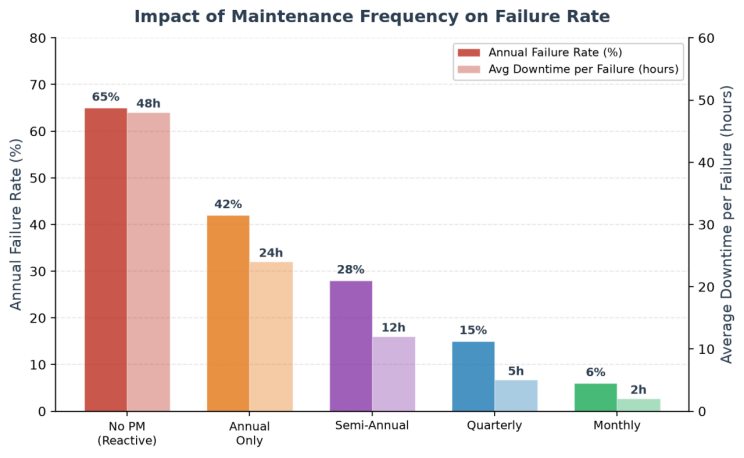
Figure 2: Impact of maintenance frequency on annual failure rate and average downtime per failure. Moving from reactive to quarterly maintenance reduces failure rate by over 75%.
3. Monthly Maintenance Tasks
Monthly tasks are the foundation of blower fan maintenance. They are quick, require no special tools, and catch the majority of problems before they escalate. AMCA recommends these tasks as the minimum baseline for any fan system in continuous or near-continuous operation [4].
2.Inspect and replace filters
A clogged filter is the single most common cause of reduced airflow and increased motor load. Check the filter visually and hold it up to a light source. If you cannot see light through the media, replace it. In dusty environments, filters may need replacement more frequently than monthly [4].
3.Visual and auditory inspection
Walk past each blower while it is running. Listen for unusual sounds: squealing (bearings), rattling (loose components or debris), humming with slow rotation (capacitor or electrical issue). Look for oil leaks around bearing housings and check that the motor housing is not discolored from heat [2].
3.Verify operating conditions
Confirm that all dampers and registers are in their intended positions. Check the system control panel for any alarm or fault indicators. If the blower has a speed controller, verify it is set to the correct operating point [1].
4.Quarterly Maintenance Tasks
Quarterly tasks go deeper than visual inspections. They require basic tools and take about 30 to 45 minutes per blower unit. These tasks catch developing problems that monthly walk-bys cannot detect [4].
5.Semi-Annual Maintenance Tasks
Semi-annual tasks focus on lubrication and mechanical adjustments that keep the blower running smoothly between annual overhauls. These tasks typically require the blower to be shut down for 1 to 2 hours [2].
1.Lubricate bearings
For blowers with regreasable bearings, apply fresh grease according to the manufacturer-specified quantity. Over-greasing is as harmful as under-greasing: excess grease causes churning, heat buildup, and seal damage. Sanyo Denki recommends using a manual grease gun and counting the number of strokes specified in the bearing data sheet to ensure the correct volume [2].
For blowers with sealed-for-life bearings, no lubrication is needed, but this is the time to check for early signs of bearing wear. Rotate the impeller by hand and feel for roughness, clicking, or excessive play. Any of these symptoms means the bearing is approaching end of life and should be replaced at the next scheduled shutdown [7].
2.Check mounting bolts and fasteners
Vibration loosens fasteners over time. Use a torque wrench to verify that all mounting bolts, motor base bolts, and housing fasteners are at the specified torque. Pay special attention to the impeller-to-shaft fastener, as a loose impeller hub can cause catastrophic failure [1].
3.Inspect flexible connectors
Flexible duct connectors isolate the blower vibration from the ductwork. Over time, these connectors crack, tear, or become brittle. Replace any connector that shows visible damage, as a failed connector transmits vibration to the duct system and creates an air leak [5].
6.Annual Maintenance Tasks

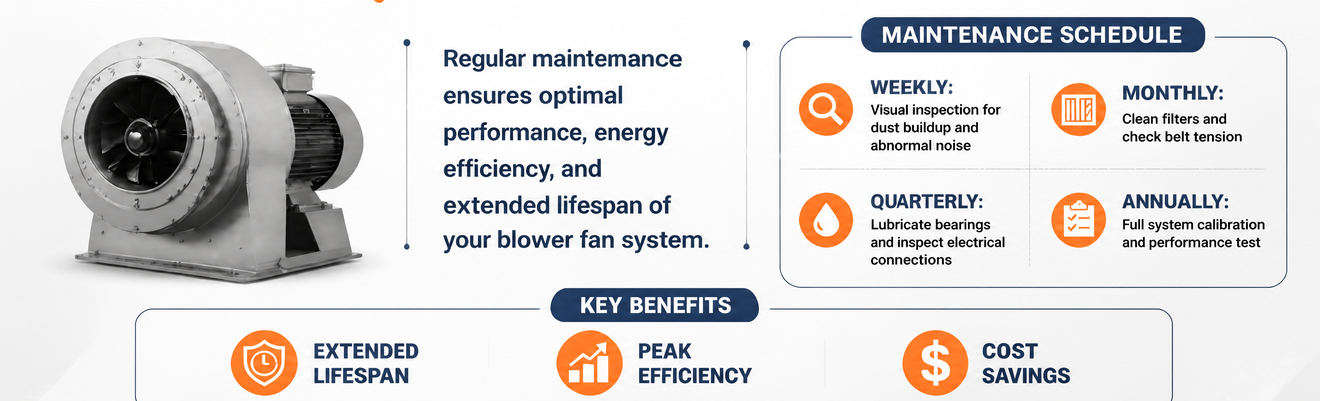
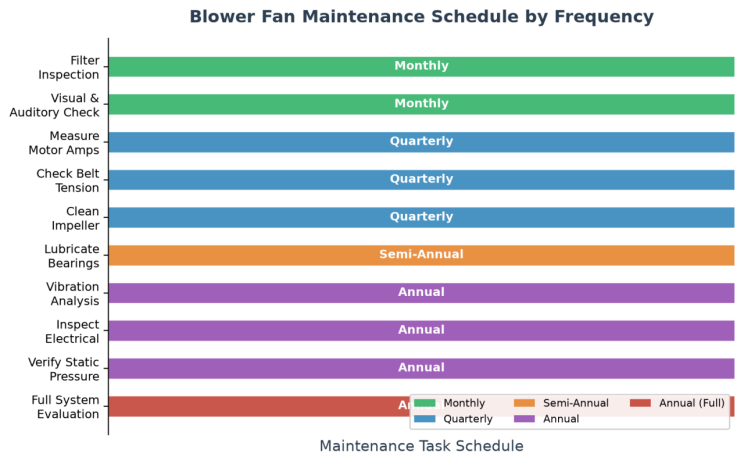
Figure 3: Complete maintenance schedule showing all tasks organized by frequency, from monthly inspections to annual full system evaluations.
Annual maintenance is the most comprehensive service interval. It involves complete system testing and may require a full day of downtime per blower. ASHRAE guidelines treat annual maintenance as the minimum standard for commercial HVAC systems [5].

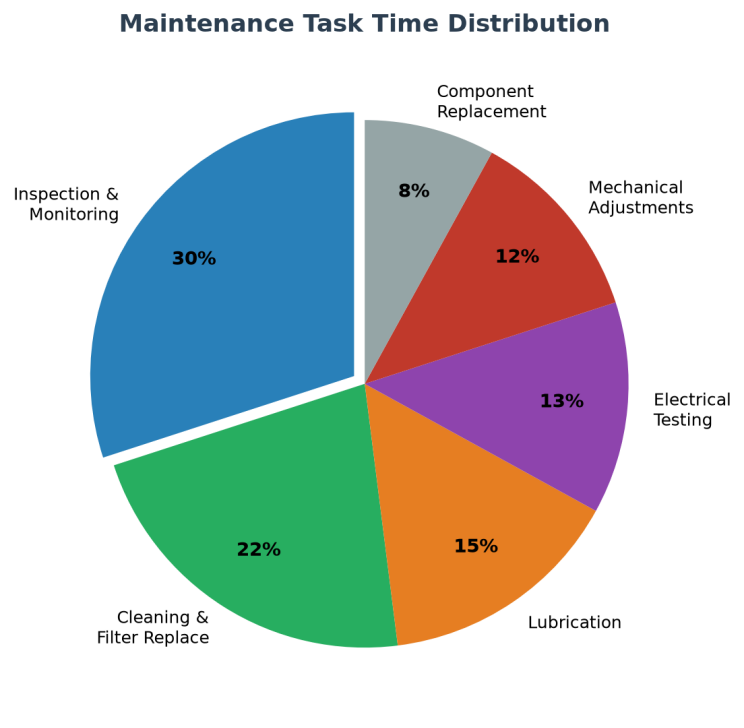
Figure 4: Distribution of maintenance labor time across task categories. Inspection and monitoring consume the largest share, followed by cleaning and filter replacement.
7. Bearing Lubrication Guidelines

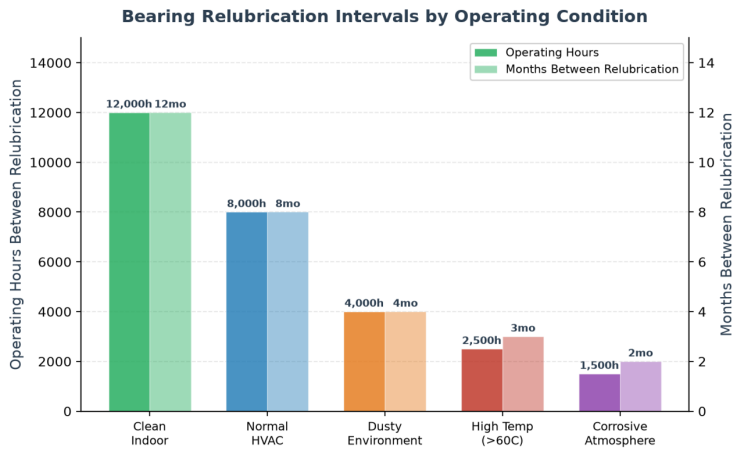
Figure 5: Recommended relubrication intervals vary dramatically by operating environment. Clean indoor applications may need grease every 12 months, while corrosive or high-temperature environments require relubrication every 2 months.
Bearing lubrication deserves its own section because it is the maintenance task most often done incorrectly. The two most common mistakes are using the wrong grease type and applying too much. Both cause more harm than good [7].
Selecting the right grease:
Standard HVAC applications: NLGI Grade 2 lithium-complex grease
High-temperature applications (>60C): Synthetic grease with polyurea thickener
Food-grade applications: NSF H1-certified grease
Never mix grease types: Incompatible thickeners can break down the grease and destroy the bearing [2]
How much grease to apply:
The correct volume depends on the bearing size. A common formula is: grease volume (grams) = bearing outside diameter (mm) x bearing width (mm) x 0.005. For a typical 6204 bearing (47 mm OD x 14 mm width), this works out to about 3.3 grams, or roughly 2 to 3 strokes of a standard manual grease gun. Sunon and Sanyo Denki both publish relubrication quantity tables in their bearing data sheets [2] [7].
After applying grease, run the blower for 10 to 15 minutes with the grease relief plug removed. This allows excess grease to purge from the bearing housing. Leaving excess grease inside causes churning heat that breaks down the lubricant and shortens bearing life [7].
8. Building a Maintenance Log
A maintenance log is the single most valuable tool for managing blower fan reliability. Without recorded data, every service call starts from scratch. With a log, you can trend measurements over time, predict failures before they happen, and make informed decisions about repair versus replacement [8].
What to record at each inspection:
Date and technician name
Filter condition and replacement date
Motor running amperage (all phases)
Vibration readings (if measured)
Bearing temperature (if accessible)
Belt tension reading (belt-driven units)
Static pressure reading (if measured)
Any unusual observations: noise, odor, visual damage
Parts replaced and grease applied
Energy Star recommends using a standardized form or digital app for each blower unit, with fields that match the maintenance schedule above. Digital logs allow automated alerts when the next inspection is due and make it easy to generate trend charts showing how amperage, vibration, or temperature has changed over time [8].
The DOE has documented that facilities with detailed maintenance logs achieve average motor life extensions of 30 to 50% compared to those without systematic record-keeping [6]. The log does not need to be sophisticated, but it must be consistent.
9. Summary
A structured blower fan maintenance schedule is the difference between equipment that runs reliably for 10 to 15 years and equipment that fails every two. The schedule is straightforward: monthly filter checks and visual inspections, quarterly amperage measurement and impeller cleaning, semi-annual bearing lubrication and fastener torque verification, and annual vibration analysis with full system evaluation.
The economics are clear. Preventive maintenance costs are predictable and modest, while reactive maintenance costs are unpredictable and escalate over time as neglected equipment degrades. Facilities that implement this schedule typically see 40 to 60% fewer unplanned failures, 10 to 20% lower energy consumption, and 30 to 50% longer equipment life. Combined with a consistent maintenance log for trend analysis, this schedule transforms blower fan management from reactive firefighting into predictable, cost-effective reliability.
10. Frequently Asked Questions
Q1: How often should I replace blower fan filters?
Under normal operating conditions, inspect filters monthly and replace them when they are visibly dirty or when you can no longer see light through the media. In clean indoor environments, filters may last 2 to 3 months. In dusty or industrial settings, they may need replacement every 2 to 4 weeks. A clogged filter is the single most common cause of reduced airflow and increased motor load, so erring on the side of frequent replacement is always cost-effective [4].
Q2: Can I use any type of grease for blower fan bearings?
No. Always use the grease type specified by the blower manufacturer. For standard HVAC applications, NLGI Grade 2 lithium-complex grease is typical. High-temperature applications may require synthetic polyurea grease. Never mix incompatible grease types, as different thickeners can chemically react and break down the lubricant. If you are switching grease types, purge the old grease completely before applying the new one [2] [7].
Q3: What vibration level is acceptable for a blower fan?
Vibration acceptability depends on the fan frame size and operating speed. ISO 10816 defines vibration severity limits for different categories of rotating machinery. As a general rule, vibration velocity below 2.3 mm/s RMS is acceptable for most blower fans in commercial HVAC. Readings between 2.3 and 4.5 mm/s indicate a developing problem that should be investigated. Above 4.5 mm/s, shut down the blower and diagnose the cause before it leads to catastrophic failure [1].
Q4: Do sealed bearings really need no maintenance?
Sealed-for-life bearings do not require relubrication, but they are not truly maintenance-free. You still need to monitor their condition during semi-annual inspections. Rotate the impeller by hand and feel for roughness, clicking, or play. Sealed bearings typically last 40,000 to 60,000 hours under normal conditions, but high operating temperature or contamination can cut that life in half. Plan for replacement before the calculated end of life to avoid unplanned failure [7].
Q5: Is it worth upgrading to an EC blower during maintenance?
It depends on your operating hours and energy costs. If your AC blower runs continuously and your electricity rate is above $0.10 per kWh, an EC blower upgrade typically pays back in 1 to 3 years through energy savings alone. The DOE has identified motor system upgrades as one of the top five efficiency measures by total savings potential. If your current blower is approaching the end of its service life, replacing it with an EC model rather than repairing the old AC motor is almost always the better economic choice [6] [8].
11. References
[1] ebm-papst Group. EC Blower Fan Service Manual: Maintenance Intervals and Vibration Guidelines. Available at: https://www.ebm-papst.com.cn/en/
[2] Sanyo Denki. Sanace Blower Fan: Bearing Maintenance and Lubrication Specifications. Available at: https://products.sanyodenki.com/en/sanace/
[3] IEEE. Rotating Machinery Insulation Testing and Motor Protection Standards. Available at: https://standards.ieee.org/
[4] AMCA International. AMCA Standard 210 and Fan System Maintenance Guidelines. Available at: https://amca.org/
[5] ASHRAE. HVAC System Commissioning and Preventive Maintenance Guidelines. Available at: https://www.ashrae.org/
[6] U.S. Department of Energy. Motor Systems Reliability and Predictive Maintenance Best Practices. Available at: https://www.energy.gov/eere/amo/motor-systems
[7] Sunon. DC Fan Bearing Technology: L10 Life Data and Relubrication Recommendations. Available at: https://www.sunon.com/en/
[8] Energy Star. HVAC Maintenance Guidelines for Commercial Buildings. Available at: https://www.energystar.gov/