Get Quote
Home > News > Fan Knowledge Sharing > EC Fan vs AC Fan: Difference Explained
EC Fan vs AC Fan: Difference Explained

EC Fan vs AC Fan: Difference Explained

AUGUST 21, 2026

Table of Contents

  1. Introduction

  2. What Is an AC Fan?

  3. What Is an EC Fan?

  4. Motor Construction: How They Differ

  5. Energy Efficiency: The Big Gap

  6. Speed Control and Controllability

  7. Noise and Vibration

  8. Lifespan and Maintenance

  9. Cost Comparison: Upfront vs Long-Term

  10. When to Choose EC vs AC

  11. Summary

  12. Frequently Asked Questions

  13. References

1.Introduction

If you have ever wondered why two fans that look almost identical can carry a threefold price difference, the answer usually comes down to two letters: EC. EC (Electronically Commutated) and AC (Alternating Current) fans are the two dominant fan technologies in HVAC, refrigeration, data centers, and industrial applications today. Both move air, but how they do it, and what they cost you in energy, noise, and maintenance over a decade of operation, could not be more different.

This article lays out the real differences between EC and AC fans without the marketing spin. Whether you are specifying equipment for a new build or deciding whether to retrofit an existing system, you will find practical, numbers-backed guidance here.

2.What Is an AC Fan?

AC fans have been the workhorse of ventilation for close to a century. They run on AC induction motors, which means the power coming from your electrical grid (120V or 230V, 50 or 60 Hz) drives the motor directly with no conversion and no electronics in between [3]. The motor's rotor spins because of the electromagnetic field induced by the stator windings, a principle that Nikola Tesla patented back in 1887.

The simplicity of AC induction motors is both their biggest strength and their biggest weakness. On the plus side, they are cheap to manufacture, rugged enough to survive harsh environments, and require minimal electronics knowledge to install. On the downside, they are locked to the frequency of the power supply. Want to run a 60 Hz fan on a 50 Hz grid? You will need a frequency converter. Want to slow the fan down to save energy? You will need a separate variable frequency drive (VFD), which adds cost, wiring complexity, and potential electromagnetic interference [7].

Most AC fans you will encounter in commercial HVAC systems are either shaded-pole motors (small, cheap, and terribly inefficient, often below 40% at full load) or permanent split capacitor (PSC) motors, which do a bit better at 50 to 65% efficiency [3].

3.What Is an EC Fan?

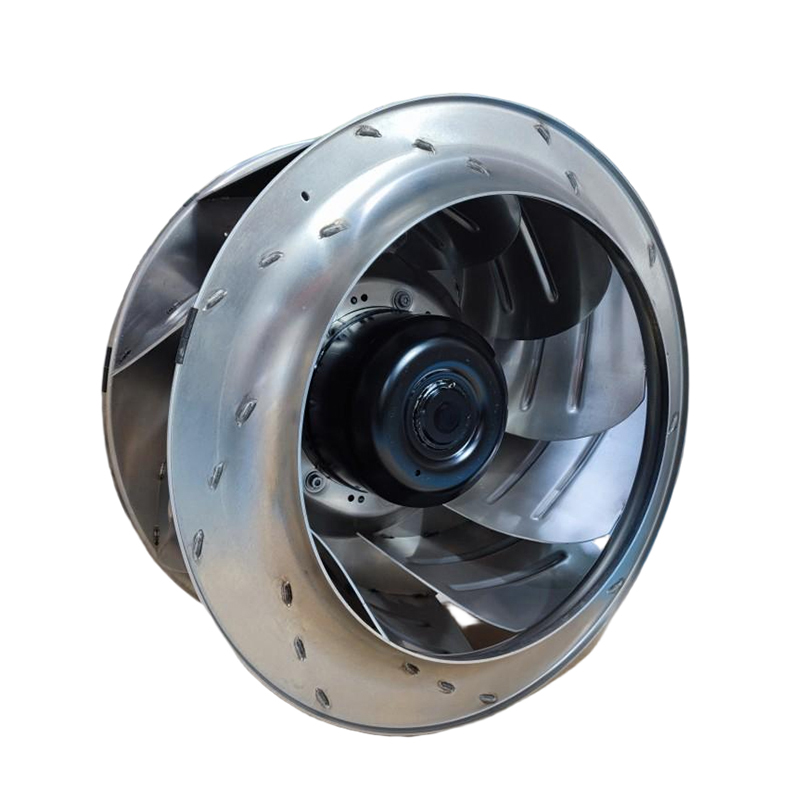
EC fans use brushless DC (BLDC) motors with integrated electronic commutation. Here is how it works: the fan accepts AC power from the grid, but built-in electronics, typically an AC-to-DC rectifier followed by an inverter, convert it to DC and then electronically switch the current in the stator windings to drive the rotor [1]. The key difference is that there are no brushes wearing out, and the electronics give you precise control over motor speed, torque, and power consumption.

Leading manufacturers like ebm-papst [1], Sanyo Denki [4], and Ziehl-Abegg [6] have spent the past two decades refining this technology. Modern EC fans routinely achieve motor efficiencies above 90%, which is a staggering improvement over traditional AC motors.

The electronics also enable features that AC fans simply cannot offer natively: stepless speed control via a 0 to 10V signal, PWM input, or even Modbus and BACnet communication; constant airflow or constant pressure control modes; and feedback signals for monitoring and diagnostics.

4.Motor Construction: How They Differ

EC Fan vs AC Fan

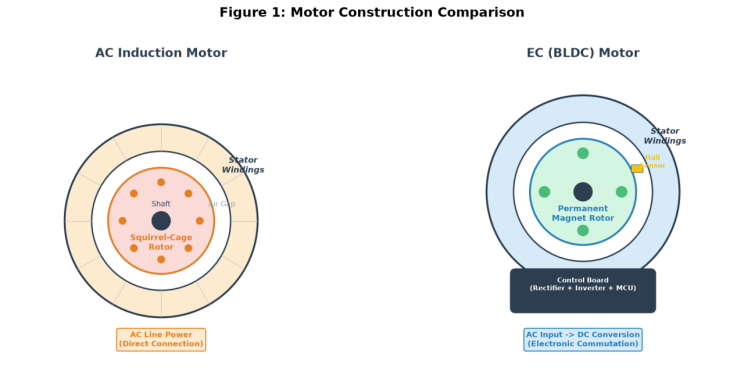
Figure 1: Cross-sectional comparison of AC induction motor and EC (BLDC) motor construction.


The construction differences between AC and EC motors go deeper than "one has electronics and the other does not."
AC Induction Motor Construction:

Stator: Laminated iron core with copper windings, energized by AC line voltage
Rotor: Squirrel-cage design (aluminum or copper bars shorted at both ends)
No permanent magnets, no built-in electronics
Bearings: Typically sleeve or ball bearings
EC (BLDC) Motor Construction:
Stator: Laminated core with multi-phase windings, energized by electronically switched DC
Rotor: Permanent magnets (typically neodymium or ferrite) bonded to the rotor hub
Built-in control board: Rectifier, inverter, microcontroller, and communication interface
Hall-effect sensors or back-EMF sensing for rotor position detection [7]
Bearings: Higher-grade ball bearings, often sealed for life

The permanent magnets in EC rotors are a significant cost driver. Neodymium magnets have fluctuated wildly in price over the past decade. But they are also what gives EC motors their efficiency advantage: the rotor does not need induced current to create a magnetic field, so there are far fewer I2R copper losses [8].

5. Energy Efficiency: The Big Gap

EC Fan vs AC Fan

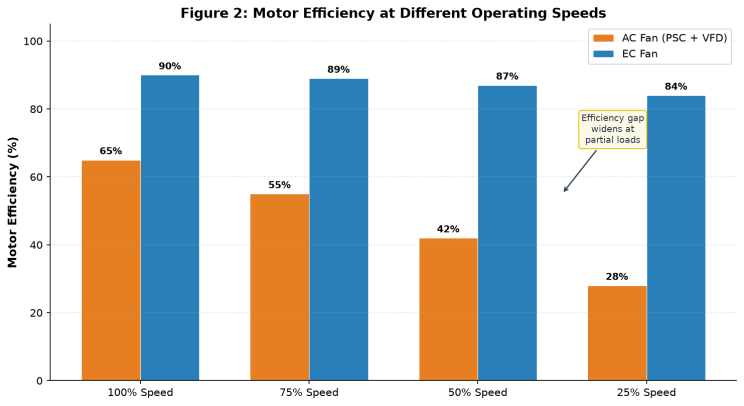
Figure 2: Motor efficiency comparison at various operating speeds. The gap widens significantly at partial loads.


This is where EC fans really pull ahead, and the numbers are worth looking at closely.

At full speed, a typical AC fan with a PSC motor draws about 200W to move 500 CFM. An equivalent EC fan moving the same airflow draws about 130W, a 35% reduction. But the real story unfolds at partial loads, which is where most fans actually operate.

When you throttle an AC fan back to 50% speed using a VFD, the motor efficiency drops significantly. The VFD itself introduces switching losses (typically 3 to 5%), and the induction motor's efficiency curve falls off a cliff at reduced speeds and reduced load [3]. At 50% speed, your AC fan might be operating at 42% efficiency. An EC fan at 50% speed? Still running at 87% efficiency, because the electronic commutation adjusts the switching pattern to maintain optimal efficiency across the entire speed range [1].

The AMCA Standard 205 energy efficiency classification for fans provides a standardized way to compare fan efficiency ratings across manufacturers [2]. Under this framework, EC fans consistently achieve the highest efficiency grades.

The affinity laws tell us that power consumption scales with the cube of speed. Running at 50% speed should theoretically use only 12.5% of full-speed power. EC fans come remarkably close to this theoretical ideal. AC fans with VFDs? Not so much.

Over a year of continuous operation, the energy savings are substantial. A data center running 20 EC fans instead of AC equivalents can save upwards of 30,000 kWh annually [5].

6. Speed Control and Controllability

EC Fan vs AC Fan

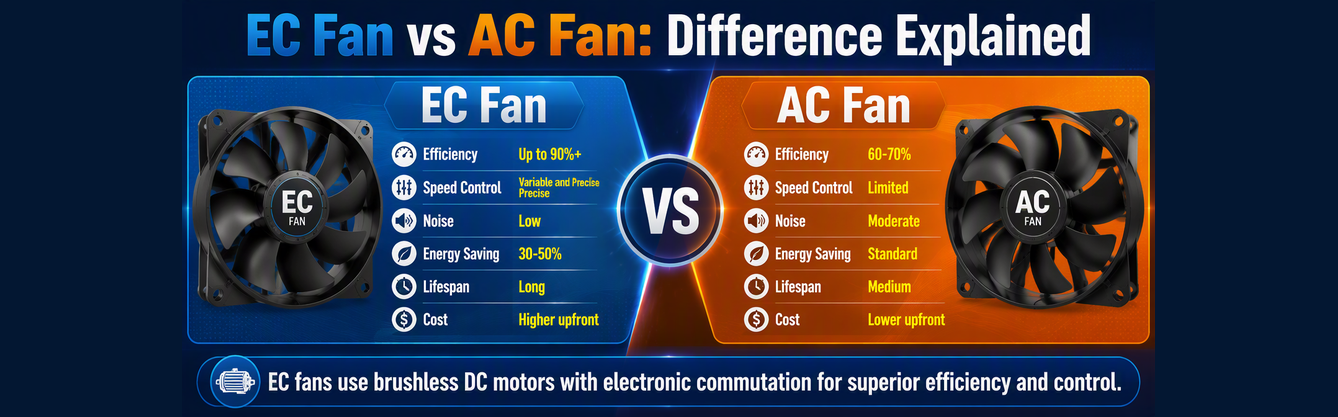
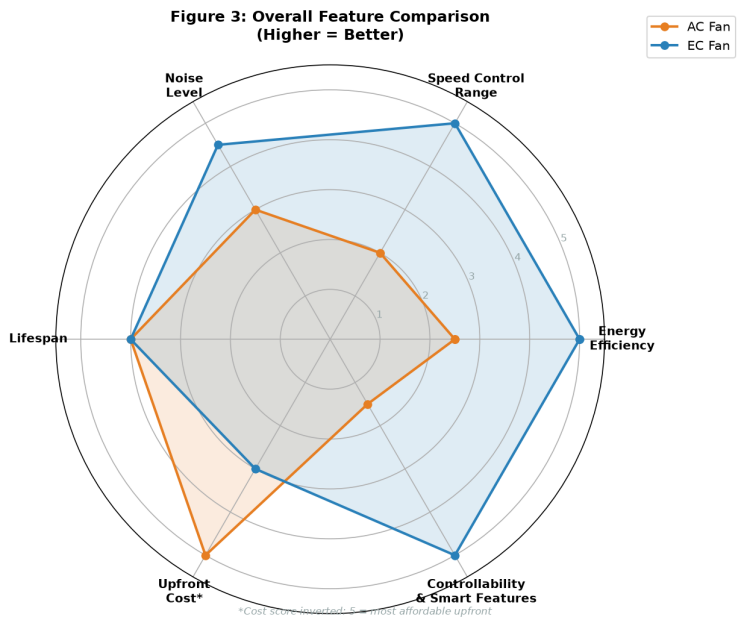
Figure 3: Overall feature comparison between AC and EC fans across key performance dimensions.


This is another area where the gap between EC and AC fans is significant.
AC Fan Speed Control Options:

Transformer-based voltage reduction: Crude, limited steps, poor efficiency
Triac or phase-angle control: Works on shaded-pole motors, creates electrical noise
VFD (Variable Frequency Drive): The most common solution for 3-phase AC motors, but adds $200 to $800 per fan and introduces harmonic distortion [7]

None at all: Many small AC fans are simply on or off

EC Fan Speed Control Options:

0 to 10V analog signal: The industry standard, simple and reliable
PWM (Pulse Width Modulation): Common in electronics cooling, allows digital control [4]
Modbus RTU or BACnet: Full digital communication, enables building management system integration
Constant airflow mode: The fan automatically adjusts speed to maintain a set CFM regardless of static pressure changes
Constant pressure mode: The fan maintains a target duct pressure, ramping up or down as dampers open and close

The ability to run in constant airflow or constant pressure mode is a game-changer for HVAC systems. Instead of a fan running at 100% all the time with dampers bleeding off excess pressure, the EC fan only works as hard as it needs to. This is one of the reasons why EC fan retrofits in Air Handling Unit (AHU) applications typically achieve 30 to 50% energy savings [5].

7. Noise and Vibration

EC Fan vs AC Fan

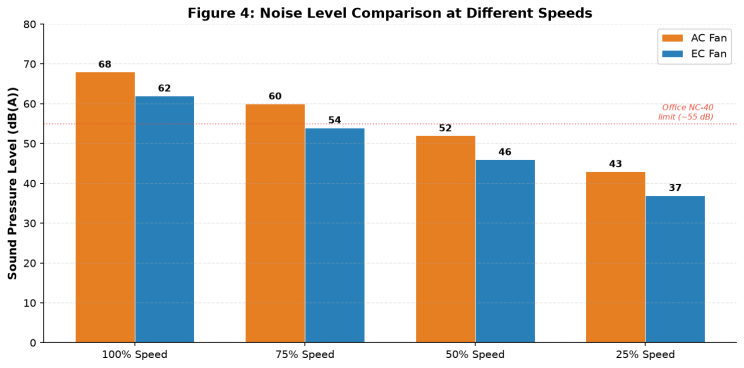
Figure 4: Noise level comparison at different fan speeds. EC fans are consistently quieter.

Noise matters more than you might think, especially in commercial buildings where background noise levels are regulated by ASHRAE Standard 90.1 and local building codes [5].

EC fans are generally quieter than AC fans for three reasons. First, the electronic commutation produces smoother torque delivery. AC induction motors have torque ripple, small fluctuations in rotational force that create vibration and audible hum at the line frequency (50 or 60 Hz). EC motors, with their multi-phase electronic switching, deliver much smoother torque [7].

Second, EC fans can run at lower speeds to achieve the same airflow. Because they are more efficient, a smaller EC fan can do the work of a larger AC fan, and running at lower RPM means less tip noise.

Third, EC fans do not have the brushes that older DC motors had, eliminating the commutator noise that plagued early DC fan designs [8].
In practice, you can expect an EC fan to be 3 to 8 dB(A) quieter than an equivalent AC fan at the same airflow. That might not sound like much, but remember that the decibel scale is logarithmic. A 6 dB reduction is perceived as roughly half as loud.

8. Lifespan and Maintenance

The lifespan comparison is nuanced. Both AC and EC fans use ball bearings, and the bearings are usually the first thing to fail in either type.

AC induction motors are mechanically simpler: no electronics, no magnets, no sensors. In a clean, stable environment, a well-built AC motor can run for 15 to 20 years with minimal attention. The stator windings are robust, and there is very little that can go wrong electrically [3].

EC fans have more components that could fail: the control board, capacitors, Hall-effect sensors, and the permanent magnets. However, modern EC fan electronics are designed for industrial environments and typically rated for 50,000 to 80,000 hours of continuous operation (that is 6 to 9 years at 24/7) [1]. In real-world applications, the most common failure mode is not the electronics. It is still the bearings.

The advantage for EC fans here is that they run cooler and at lower speeds for the same airflow, which extends bearing life. Also, many EC fans provide diagnostic feedback (RPM, current draw, temperature) that allows predictive maintenance before a failure occurs [4].

9. Cost Comparison: Upfront vs Long-Term

EC Fan vs AC Fan

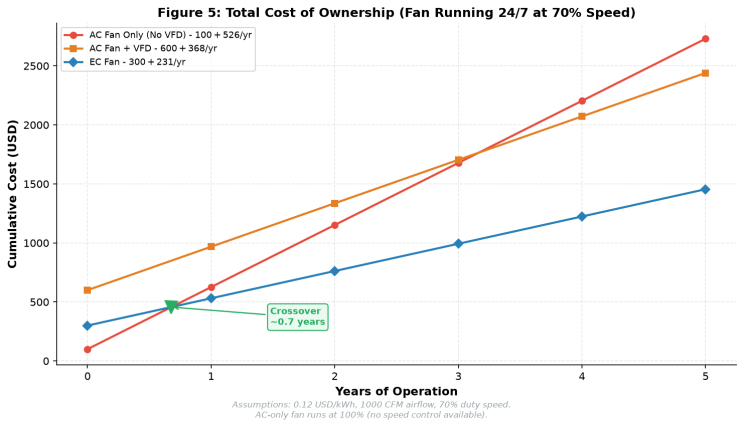
Figure 5: Total cost of ownership over 5 years for three scenarios. EC fans reach cost parity quickly.

Let us talk about money, because that is what ultimately drives most purchasing decisions.

Upfront Cost:

AC fan (PSC motor): $50 to $150 for a typical commercial unit
AC fan with VFD: $300 to $1,000 (fan + drive + installation)
EC fan: $150 to $500 for the same size

EC fans cost roughly 2 to 3 times more than a bare AC fan. But if you need speed control, the comparison shifts. A VFD-equipped AC system often costs more than an EC fan with built-in control.

Operating Cost (the real story):

Let us say you have a fan running 24/7 at 70% speed, moving about 1,000 CFM:

AC fan with VFD: approximately 350W, which is 3,066 kWh per year, about $368 per year at $0.12 per kWh
EC fan: approximately 220W, which is 1,927 kWh per year, about $231 per year at $0.12 per kWh
Annual savings: about $137 per fan
Over 5 years, that is $685 in energy savings per fan, which often exceeds the price difference. In data centers running dozens of fans, the payback can be under 18 months [2].

The U.S. Department of Energy has noted that motor-driven systems account for about 70% of industrial electricity consumption, and upgrading to higher-efficiency motors is one of the most cost-effective energy conservation measures available [3]. Energy Star guidelines also recognize EC motor technology as a key strategy for reducing building energy use [8].

10. When to Choose EC vs AC

There is no universal "EC is always better" answer, despite what some manufacturers' brochures might suggest. Here is a practical decision framework.
Choose AC fans when:

The fan runs at constant full speed 24/7 (efficiency differences shrink at full load)
The environment is extremely harsh (high temperature, corrosive, high vibration) where electronics might fail
The budget is very tight and the duty cycle is low (intermittent use)
Simple on/off control is all you need

Choose EC fans when:

Variable speed control is needed (which covers most modern HVAC applications)
The fan runs many hours per year (the energy savings compound quickly)
Noise is a concern (residential, office, hospital environments)
You need communication with a building management system
You are retrofitting an AHU or FCU and want to avoid external VFDs [5]
Energy codes or utility rebates incentivize high-efficiency equipment

11. Summary

EC and AC fans both have their place. AC fans win on simplicity, ruggedness, and upfront cost. EC fans win on efficiency, controllability, noise, and long-term operating cost. For most modern commercial and industrial applications, especially those with variable loads, the total cost of ownership strongly favors EC technology. But for simple, constant-speed applications in harsh environments, a well-built AC fan remains a perfectly defensible choice.
The gap between these two technologies will likely widen as energy codes tighten and EC manufacturing costs continue to come down. But for now, understanding the trade-offs, rather than defaulting to one technology, is the key to making the right specification.

12. Frequently Asked Questions

Q1: Can I replace an AC fan with an EC fan in my existing system?

In most cases, yes. EC fans are available in the same frame sizes as AC fans, so they will fit physically. However, you will need to check the power supply (EC fans accept AC input but may have different current draw characteristics), and you will want to wire up a speed control signal (0 to 10V or PWM) to take advantage of the EC fan's capabilities. If your existing system used a VFD with the AC fan, the VFD can typically be removed [5].

Q2: Do EC fans produce electromagnetic interference (EMI)?

EC fans do generate some EMI due to the high-frequency switching in their electronics. However, reputable manufacturers design their products to comply with FCC Part 15 and CE EMC directives. In practice, EMI from EC fans is rarely an issue in commercial or industrial settings. If you are in a sensitive environment like a hospital with medical equipment, look for fans with additional shielding and filtered power inputs [7].

Q3: What is the typical payback period for switching from AC to EC fans?

It depends on your duty cycle and electricity rate. For fans running 24/7 at partial loads, the payback is typically 1 to 3 years. For fans running only during business hours (about 2,500 hours per year), expect 3 to 5 years. Fans running at constant full speed in non-critical applications may never pay back the premium, which is why EC is not always the right choice [3].

Q4: Are EC fans more difficult to maintain?

Not really. The electronics in modern EC fans are sealed and designed for long service life. Routine maintenance is the same as for AC fans, primarily bearing inspection and cleaning. The advantage is that EC fans often provide diagnostic feedback (RPM, current, fault codes) that makes troubleshooting easier, not harder [1].

Q5: Can EC fans be used outdoors?

Yes, but with caveats. The electronics need protection from moisture and temperature extremes. Many EC fan manufacturers offer IP55 or IP66 rated versions for outdoor use. If the ambient temperature regularly exceeds 50 degrees Celsius (122 degrees Fahrenheit) or drops below -20 degrees Celsius (-4 degrees Fahrenheit), check the manufacturer's specifications carefully, as the control board may need additional protection [4].

13. References

[1] ebm-papst Group. EC Technology. Available at: https://www.ebm-papst.com.cn/en/
[2] AMCA International. AMCA Standard 205 - Energy Efficiency Classification for Fans. Available at: https://amca.org/
[3] U.S. Department of Energy. Motor Systems. Available at: https://www.energy.gov/eere/amo/motor-systems
[4] Sanyo Denki. Sanace Fan Products. Available at: https://products.sanyodenki.com/en/sanace/
[5] ASHRAE. ASHRAE Handbook - HVAC Applications. Available at: https://www.ashrae.org/
[6] Ziehl-Abegg. ECblue Technology. Available at: https://www.ziehl-abegg.com/en/
[7] IEEE. Neethu, U. and Jisha, V.R. (2012). "Speed control of brushless DC motor: A comparative study." International Conference on Power, Signals, Controls and Computing (EPSCICON). Available at: https://standards.ieee.org/
[8] Energy Star. Energy Star Guidelines for HVAC Efficiency. Available at: https://www.energystar.gov/