Table of Contents
1.Article Summary
2.Introduction: EC Fans in the HVAC Landscape
3.Why HVAC Systems Need Variable-Speed Fans
4.Application 1: Air Handling Units (AHUs)
5.Application 2: Data Center Cooling
6.Application 3: Fan Coil Units (FCUs)
7.Application 4: Refrigeration and Cold Storage
8.Application 5: Heat Recovery Ventilation
9.Application 6: Indoor Agriculture and Grow Facilities
10.Retrofitting Existing HVAC Systems with EC Fans
11.Energy Savings: Real-World Data
12.Regulatory Landscape and Efficiency Standards
13.Frequently Asked Questions (FAQ)
14.References
1.Article Summary
Electronically Commutated (EC) fans have moved from a niche technology to a mainstream choice across virtually every segment of the HVAC industry. Their combination of brushless DC motor efficiency, built-in speed control, and compact form factor makes them well-suited for applications ranging from air handling units in commercial buildings to precision cooling in data centers. This article examines the six most significant HVAC applications where EC fans deliver measurable benefits: air handling units, data center cooling, fan coil units, refrigeration systems, heat recovery ventilators, and indoor agriculture. For each application, we explain why EC technology fits, what energy savings operators can realistically expect, and what practical considerations matter during selection and installation. We also cover retrofitting existing systems, share real-world energy data from published research, and discuss the regulatory standards driving the shift toward higher fan efficiency.
2.Introduction: EC Fans in the HVAC Landscape
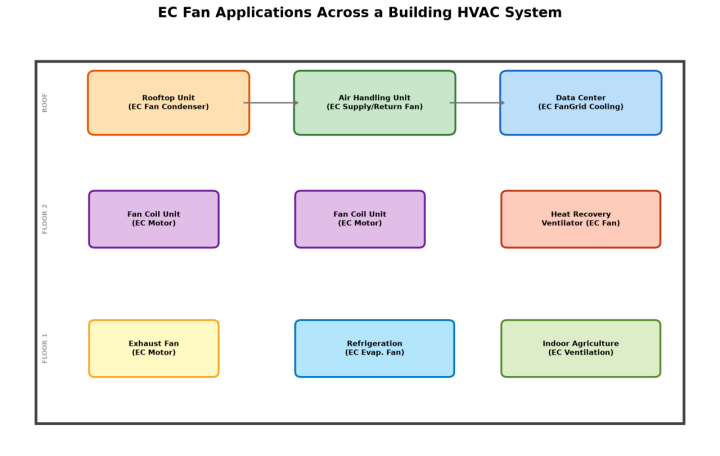
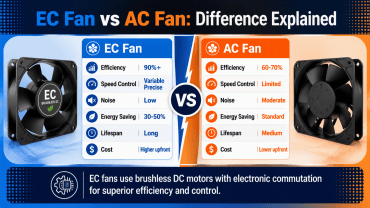
If you walk into any modern commercial building and trace the airflow from the rooftop unit down to the terminal devices in each room, you will likely find EC fans at multiple points along the way. These fans use brushless DC motors with integrated electronics that convert AC line power to DC internally, eliminating the need for external variable frequency drives while delivering stepless speed control and maintaining high efficiency even at low speeds.
The HVAC industry has embraced EC fans because they solve several problems at once. Traditional AC fans run at fixed speed, and the only way to reduce airflow is to throttle it with dampers, which wastes energy. Variable frequency drives can make AC fans variable-speed, but they add cost, complexity, and harmonic distortion to the electrical system. EC fans sidestep both issues. The motor electronics handle speed control natively, and the brushless design operates at efficiencies above 90% across a wide operating range.

Figure 1. EC fans appear at multiple points in a building HVAC system, from rooftop units to terminal devices and exhaust systems.
Leading manufacturers including ebm-papst [1], Sanyo Denki, Ziehl-Abegg, and FläktGroup [3] have developed extensive EC fan product lines specifically for HVAC applications. These products range from small inline fans for residential ventilation to large centrifugal fans capable of moving tens of thousands of cubic feet per minute in commercial air handlers.
3. Why HVAC Systems Need Variable-Speed Fans
HVAC systems rarely need to operate at full capacity continuously. A building's cooling load changes throughout the day as occupancy fluctuates, sunlight shifts, and outdoor temperature varies. Heating demand follows similar patterns. When fans run at fixed speed regardless of actual load, they waste significant energy during partial-load conditions, which represent the majority of operating hours in most buildings.
The fan affinity laws explain why this matters so much. Power consumption is proportional to the cube of fan speed. Reducing speed by 20% cuts power draw by nearly 50%. At 50% speed, the fan consumes only about 12.5% of full-load power. This cubic relationship means that even modest speed reductions during off-peak hours add up to substantial energy and cost savings over a year of operation [7].
.png)
Figure 2. At partial loads, EC fans with variable speed control consume dramatically less power than AC fans throttled by dampers.
EC fans make this variable-speed operation practical and affordable. Because the control electronics are built into the fan, there is no external drive to purchase, wire, or maintain. The fan accepts a simple control signal, whether 0-10V analog, PWM digital, or a Modbus serial command, and adjusts its speed accordingly. This simplicity is a major reason why EC fans have become the default choice in new HVAC equipment.
4. Application 1: Air Handling Units (AHUs)
Air handling units are the workhorses of commercial HVAC. They condition and circulate air throughout a building, and their fans typically account for the largest share of the unit's energy consumption. In a conventional AHU, a belt-driven AC fan runs at constant speed while dampers modulate airflow to match demand. This approach works, but it is inefficient. The motor, belts, and sheaves introduce mechanical losses, and damper throttling wastes energy fighting against restricted airflow.
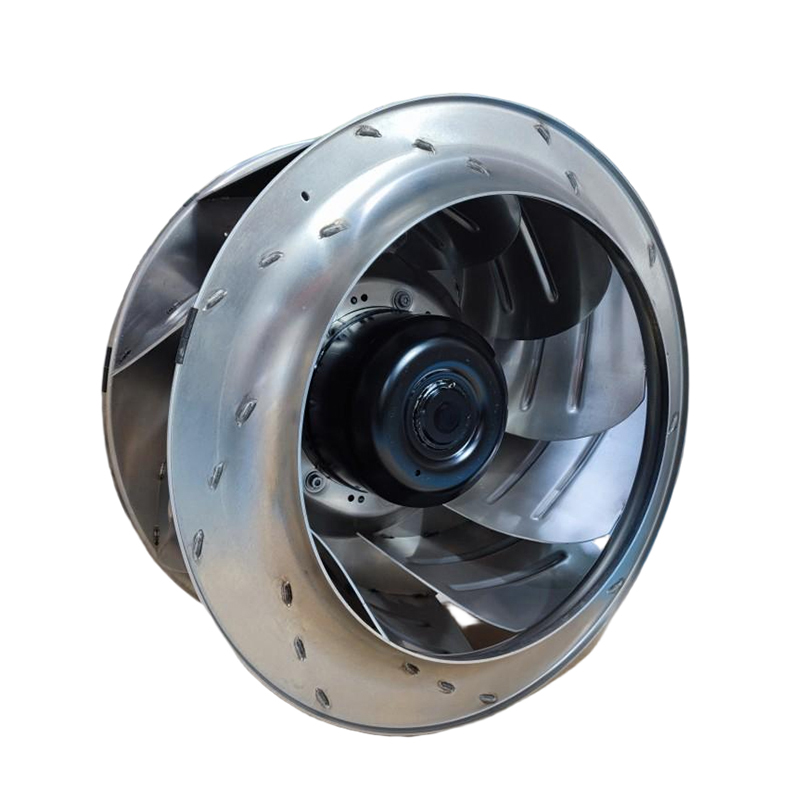
EC fans, particularly EC plug fans (also called plenum fans), offer a better approach. A plug fan is a centrifugal fan without a scroll housing. The impeller pressurizes the entire plenum chamber in which it sits, and the air exits through duct connections in the chamber walls. This design eliminates the scroll housing, reduces footprint, and allows multiple duct takeoffs from a single fan. When the plug fan uses an EC motor with direct-drive configuration, the belts and sheaves disappear entirely. The impeller mounts directly on the motor shaft, which eliminates belt losses, reduces maintenance, and removes a source of airborne particulate contamination from belt wear.
.png)
Figure 3. Retrofitting a traditional belt-driven AC fan AHU with a direct-drive EC plug fan eliminates belt losses and enables variable-speed operation.
Most modern AHU manufacturers now offer EC fan options as standard [1]. The fans integrate seamlessly with building automation systems through 0-10V or Modbus interfaces, allowing the AHU controller to adjust fan speed based on duct static pressure, CO2 levels, or scheduled occupancy profiles. Field studies have shown that AHU retrofits from belt-driven AC fans to EC plug fans typically reduce fan energy consumption by 30% to 50%, with some installations reporting even higher savings when combined with optimized control sequences.
5. Application 2: Data Center Cooling
Data centers are among the most energy-intensive facilities in the world. According to ebm-papst [1], cooling can account for nearly half of a data center's total energy consumption. As server rack densities increase, particularly with the rise of AI and high-performance computing workloads, the demand for efficient, responsive cooling has never been greater.
EC fans address this challenge through a modular approach known as a FanGrid [2]. Instead of relying on a single large fan, a FanGrid uses multiple smaller EC centrifugal fans operating in parallel. This configuration provides inherent redundancy. If one fan fails, the remaining fans can increase their speed to compensate, maintaining cooling capacity until the failed module is replaced. The modular design also allows each fan to adjust its speed independently, matching airflow to the actual heat load in different zones of the data hall.
.png)
Figure 4. A FanGrid replaces a single large fan with multiple EC fans operating in parallel, providing redundancy and granular speed control.
Data center operators particularly value the ability to implement free cooling strategies using EC FanGrids. When outdoor conditions permit, the fans draw in cool outside air and exhaust hot air, bypassing mechanical refrigeration entirely. The fans modulate their speed to maintain precise temperature differentials, maximizing the hours of free cooling operation while minimizing fan energy. FläktGroup [3], a major supplier of data center cooling solutions, emphasizes that precise air movement management is critical as rack densities climb and AI-driven workloads create dynamic, unpredictable heat patterns.
6. Application 3: Fan Coil Units (FCUs)
Fan coil units are terminal devices that provide heating or cooling to individual rooms or zones. They typically consist of a fan, a heating or cooling coil, and a filter, all housed in a compact cabinet. In traditional FCUs, AC motors with multi-tap windings provide two or three fixed speeds. The thermostat selects a speed, and the fan runs at that speed until the thermostat is satisfied.
EC motors have transformed FCU design. An EC fan in a fan coil unit can modulate its speed continuously rather than stepping between fixed speeds. This capability improves temperature control precision, reduces temperature swings, and lowers energy consumption. EC FCUs also run quieter at reduced speeds, which matters enormously in hotel rooms, hospital wards, and office spaces where occupants are sensitive to noise.
The efficiency gains are significant. A study published in the Journal of Electrical Engineering documented a real-world AHU blower retrofit from an AC induction motor with VFD to an EC BLDC motor [6]. The results showed a 45% reduction in energy consumption and a 15% reduction in current total harmonic distortion. While that study focused on AHU-scale equipment, the same principles apply at the FCU scale, where the cumulative energy savings across hundreds of units in a large building can be substantial.
7. Application 4: Refrigeration and Cold Storage
Supermarket refrigeration systems, cold storage warehouses, and commercial refrigerated display cases all rely on fans to circulate air over evaporator coils. Traditionally, these fans run continuously at full speed, regardless of the actual refrigeration load. During defrost cycles, low-load periods, or when doors are closed on display cases, the fans move more air than necessary, wasting energy and adding heat to the refrigerated space.
EC evaporator fans solve this by varying their speed to match the actual cooling demand. When the compressor cycles off or the case temperature is satisfied, the fan can drop to a minimum speed rather than stopping entirely. This maintains gentle air circulation to prevent temperature stratification while cutting fan power dramatically. Because the fan adds less heat to the space at reduced speed, the refrigeration compressor also works less, creating a compounding energy savings effect.
In supermarket retrofits, replacing standard shaded-pole or PSC evaporator fan motors with EC motors is one of the most cost-effective energy efficiency measures available. The U.S. Department of Energy [5] has identified fan motor upgrades in commercial refrigeration as a high-priority efficiency opportunity, and many utility rebate programs specifically target this application.
8. Application 5: Heat Recovery Ventilation
Heat recovery ventilators (HRVs) and energy recovery ventilators (ERVs) bring fresh outdoor air into a building while exhausting stale indoor air, transferring heat (and in ERVs, moisture) between the two airstreams. These systems are increasingly required by building energy codes to ensure adequate ventilation without the energy penalty of conditioning untempered outside air [4].
EC fans are ideal for HRV and ERV applications for two reasons. First, they need to run continuously at low speed to provide baseline ventilation, with periodic boosts when humidity or CO2 sensors trigger higher airflow. EC motors maintain high efficiency at these low speeds, where AC motors drop off significantly. Second, the balanced airflow between supply and exhaust is critical for heat recovery effectiveness. EC fans with precise speed control allow the system to maintain this balance across a wide range of operating conditions.
In residential HRV units, a pair of small EC fans typically provides both supply and exhaust airflow. The compact size, quiet operation, and variable-speed capability of EC technology make it possible to package a complete heat recovery system in a unit small enough to install in a closet or above a ceiling.
9. Application 6: Indoor Agriculture and Grow Facilities
Indoor agriculture, including vertical farms, greenhouse operations, and cannabis cultivation facilities, represents a rapidly growing market for EC fans. These environments require precise control of temperature, humidity, and CO2 concentration. The fans must move large volumes of air to distribute heat from grow lights, remove moisture transpired by plants, and maintain uniform CO2 levels across the growing area.
EC fans excel in this environment because they can respond quickly to changing conditions. When grow lights cycle on, heat output spikes within seconds. EC fans ramp up immediately to remove the additional heat, then drop back down when lights cycle off. The speed control precision also allows growers to maintain consistent microclimates across different growing zones, which directly impacts crop yield and quality.
Integration with climate controllers via Modbus RTU or 0-10V analog signals allows the grow facility's central control system to coordinate fan speeds with other equipment, such as dehumidifiers, CO2 injectors, and lighting schedules. This level of integration is difficult to achieve with fixed-speed AC fans.
10. Retrofitting Existing HVAC Systems with EC Fans
One of the most compelling aspects of EC fan technology is its suitability for retrofitting existing HVAC equipment. Building owners do not need to replace an entire air handler or rooftop unit to capture the benefits. In many cases, the old belt-driven AC fan and motor assembly can be removed and replaced with a direct-drive EC fan module that fits in the same cabinet space.
The retrofit process typically involves four steps. First, the existing fan, motor, belts, and sheaves are removed. Second, the EC fan module is mounted in the fan section, often using adapter rails or a sub-base that matches the original mounting pattern. Third, the control wiring is connected to the building automation system or a standalone controller. Fourth, the system is commissioned, which includes verifying airflow, setting minimum and maximum speed limits, and tuning the control response.
The payback period for EC fan retrofits depends on the operating hours, the partial-load profile, and local electricity rates. In facilities with continuous operation, such as data centers and hospitals, payback periods of 1 to 3 years are common. In buildings with seasonal operation, the payback may extend to 3 to 5 years, but the improvement in occupant comfort and the reduction in maintenance costs from eliminating belts and sheaves add further value beyond pure energy savings.
11. Energy Savings: Real-World Data
The energy savings from EC fan applications in HVAC are not theoretical. Multiple published studies and field installations document the results.
AHU retrofit study: A retrofit study published in the Journal of Electrical Engineering replaced an AHU's AC induction motor and VFD with an EC BLDC motor [6]. The result was a 45% reduction in energy consumption and a 15% reduction in current total harmonic distortion.
Mining ventilation: Research published in Springer's Discover Applied Sciences demonstrated that a 10% reduction in fan speed saved approximately 30.59 kW in a mining ventilation system, while a 20% reduction nearly doubled bearing life [7].
Commercial refrigeration: Supermarket evaporator fan retrofits from shaded-pole motors to EC motors routinely achieve 50-70% fan energy reduction, with additional compressor savings from reduced heat load [5].
Data center FanGrids: Data center FanGrid installations report energy savings of 30-50% compared to single large fans, particularly when combined with free cooling strategies that exploit the fans' wide turndown range [2].
.png)
Figure 5. EC fan market share across major HVAC application segments.
12. Regulatory Landscape and Efficiency Standards
The shift toward EC fans in HVAC is not driven by technology alone. Regulatory standards are increasingly mandating higher fan efficiency, and EC technology is often the most practical way to meet these requirements.
ASHRAE Standard 90.1 [4], the energy standard for buildings except low-rise residential buildings, has progressively tightened fan power limitations in each successive edition. The 2019 version, which the U.S. Department of Energy [5] determined would generate site energy savings of approximately 4.7% compared to the 2016 version, includes specific fan motor efficiency requirements that favor EC technology. ASHRAE Standard 90.1-2022 introduced further changes to the performance compliance paths, making it harder to meet energy targets with fixed-speed fan designs.
The DOE's 2023 minimum efficiency requirements for commercial HVAC equipment, which took effect on January 1, 2023, raised the bar for air conditioning and heat pump efficiency [8]. While these regulations primarily target equipment-level metrics like SEER2 and IEER, the downstream effect is that manufacturers need more efficient components, including fans, to meet the new thresholds. EC fans, with their ability to maintain high efficiency at partial loads, give manufacturers a viable path to compliance.
AMCA International [9], the Air Movement and Control Association, has also developed fan efficiency grades (FEG) that provide a standardized way to compare fan efficiency. EC fans typically achieve higher FEG ratings than comparable AC fans, particularly at non-design operating points.
13. Frequently Asked Questions (FAQ)
Q1: Can I replace the AC fan in my existing AHU with an EC fan without replacing the entire unit?
In many cases, yes. Several manufacturers offer EC fan retrofit kits designed to fit into standard AHU cabinets. The process involves removing the old fan wheel, motor, belts, and sheaves, then mounting a direct-drive EC fan module using adapter rails. You will also need to connect a control signal (0-10V, PWM, or Modbus) to regulate the fan speed. The retrofit is most straightforward when the existing AHU has enough physical clearance for the EC fan module and when a compatible control interface is available. A qualified HVAC contractor or the AHU manufacturer can assess feasibility for your specific unit.
Q2: How much noise reduction can I expect from switching to EC fans in my HVAC system?
EC fans are generally quieter than equivalent AC fans for two reasons. First, the brushless DC motor produces less electromagnetic noise and mechanical vibration than an AC induction motor. Second, and more significantly, EC fans can run at reduced speed during partial-load conditions, and fan noise drops dramatically with speed. A fan running at 70% speed produces roughly 8-10 dB less noise than at full speed. In practical terms, occupants often notice the difference immediately, particularly in quiet environments like offices, hotel rooms, and hospital wards. The exact noise reduction depends on the application, the operating profile, and how the fan is integrated into the system acoustically.
Q3: Are EC fans suitable for outdoor HVAC applications like rooftop units and cooling towers?
Yes. Most major EC fan manufacturers offer products specifically rated for outdoor use, with IP54 or higher ingress protection, corrosion-resistant coatings, and UV-stabilized housings. These fans are commonly used in rooftop condenser units, cooling towers, and outdoor air handlers. However, it is important to verify that the specific fan model carries the appropriate environmental rating for your installation conditions. Coastal environments with salt spray, for example, may require stainless steel or specially coated components that go beyond standard outdoor ratings.
Q4: What is the typical payback period for retrofitting EC fans in a commercial building?
Payback periods vary widely depending on the application, operating hours, electricity rates, and available utility rebates. In facilities that operate 24/7, such as data centers and hospitals, the payback can be as short as 1 to 2 years. In commercial office buildings with standard business-hour operation, the payback typically ranges from 3 to 5 years. Utility rebate programs can significantly shorten this timeline. Many utility companies offer incentives specifically for EC fan retrofits in commercial refrigeration and HVAC, sometimes covering 30-50% of the project cost. The elimination of belt maintenance also reduces ongoing operating costs, which should be factored into the total return on investment.
Q5: Do EC fans require special maintenance compared to traditional AC fans?
EC fans generally require less maintenance than belt-driven AC fans, primarily because they eliminate belts, sheaves, and belt guards. There are no belts to tension, replace, or inspect for wear. The bearings in an EC motor are typically permanently lubricated and rated for the motor's full service life. Routine maintenance is limited to periodic inspection of the impeller for dust or debris accumulation, verifying that the control wiring connections are secure, and checking that the fan responds correctly to control signals. In most cases, the maintenance burden is lower, not higher, compared to traditional fan systems.
14. References
[1] ebm-papst Group. Air conditioning technology: EC fans for AHUs, fan coil units, heat pumps, and data center cooling. https://www.ebmpapst.com.cn/cn/en/industries/air-conditioning.html
[2] ebm-papst Group. FanGrids: Energy-efficient modular EC centrifugal fan solutions for large air volumes and data center free cooling. https://www.ebmpapst.com.cn/en/industries/air-conditioning/fangrids.html
[3] FläktGroup. Data centre cooling solutions: precision cooling for hyperscale and enterprise data centres. https://www.flaktgroup.com/en/applications/data-centres/server-room/
[4] ASHRAE. ANSI/ASHRAE/IES Standard 90.1: Energy Standard for Sites and Buildings Except Low-Rise Residential Buildings. https://www.ashrae.org/
[5] U.S. Department of Energy. Building Technologies Office: energy efficiency standards and commercial building HVAC system research. https://www.energy.gov/eere/buildings
[6] Neethu, U. and Jisha, V.R. (2012). Speed Control of Brushless DC Motor: A Comparative Study. IEEE International Conference on Power Electronics, Drives and Energy Systems. https://ieeexplore.ieee.org/document/6464491
[7] Siddiqui, M.A. et al. (2025). Maximizing energy savings in coal mines industrial ventilation: strategies and analysis for power reduction. Discover Applied Sciences, Springer. https://link.springer.com/article/10.1007/s42452-025-06989-0
[8] Johnson Controls. HVAC efficiency solutions and building technologies for commercial and industrial applications. https://www.johnsoncontrols.com/
[9] AMCA International. Fan efficiency grades, certified ratings program, and air movement standards. https://amca.org/