Get Quote
Home > News > Fan Knowledge Sharing > Blower Fan Energy Savings
Blower Fan Energy Savings

Blower Fan Energy Savings

SEPTEMBER 07, 2026

  1. Introduction

  2. Why Blower Fan Energy Consumption Matters

  3. EC Blower Fans vs Traditional AC Motors

  4. The Affinity Laws and Speed Control Savings

  5. Partial-Load Performance and Control Methods

  6. Real-World Energy Cost Comparisons

  7. Payback Period and ROI Calculation

  8. Application-Specific Savings Opportunities

  9. Summary

  10. Frequently Asked Questions

  11. References

1.Introduction

Blower fans are the workhorses of modern ventilation, moving air through HVAC ducts, server racks, industrial processes, and cleanroom exhaust systems. They also consume a significant amount of electricity. The U.S. Department of Energy estimates that motor-driven systems account for roughly 70% of industrial electricity consumption, with fans and blowers representing one of the largest segments [6]. For facility managers and design engineers, reducing blower fan energy consumption is one of the highest-impact efficiency measures available.
The shift from traditional AC induction motors to electronically commutated (EC) blower fans has changed the energy landscape. EC blowers combine permanent-magnet DC motor technology with built-in speed control, delivering efficiency gains of 30% or more compared to fixed-speed AC alternatives [1]. This article breaks down where those savings come from, how to calculate them, and what payback periods to expect when upgrading.

2.Why Blower Fan Energy Consumption Matters

Fans and blowers rarely run at full capacity around the clock. In HVAC systems, airflow demand varies with occupancy, outdoor temperature, and seasonal changes. In server rooms, cooling load tracks computing workload. In industrial processes, exhaust requirements shift with production cycles. Despite this variability, many facilities still rely on fixed-speed AC blowers controlled by dampers or inlet vanes, which throttle airflow mechanically while the motor keeps drawing near-full power [4].

The waste is substantial. AMCA International has documented that throttling airflow with a damper while running a motor at full speed can waste 40 to 70% of the input electrical energy, depending on how much the airflow is reduced [4]. The energy lost as heat through the damper or vane does no useful work. It simply shows up on the electricity bill month after month.

Energy Star reports that upgrading to variable-speed fan systems is one of the most cost-effective efficiency measures for commercial buildings, with typical payback periods under three years [8]. The opportunity is not limited to large facilities. Even small blower fans in telecom cabinets or medical devices can benefit, because the efficiency gains scale with the affinity laws regardless of system size.

3.EC Blower Fans vs Traditional AC Motors

Blower Fan Energy Savings

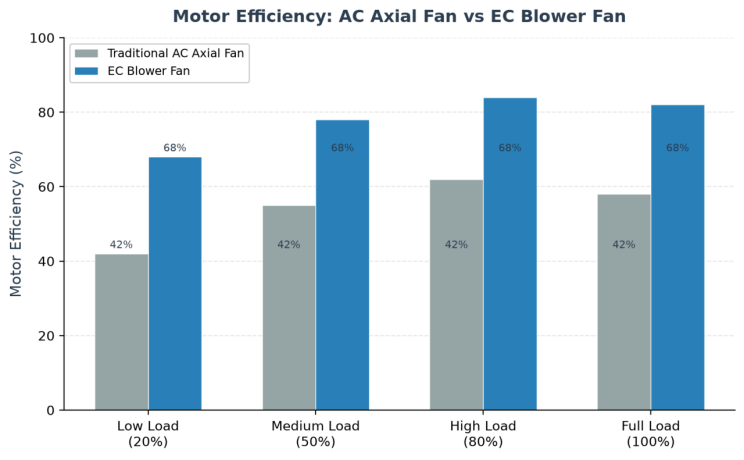
Figure 1: Motor efficiency comparison between traditional AC axial fans and EC blower fans across different load conditions. EC motors maintain high efficiency even at partial loads where AC motors drop off significantly.

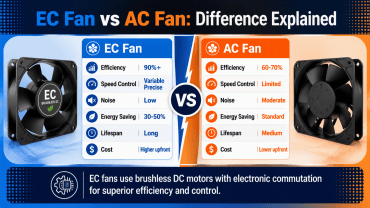
The core difference between an EC blower and a traditional AC motor blower is how the motor converts electrical energy into rotational motion. AC induction motors rely on electromagnetic induction between the stator and rotor, which inherently involves slip losses and reactive current. EC motors use permanent magnets on the rotor and electronic commutation, eliminating slip losses and allowing precise control of motor speed and torque [1].

At full load, a quality AC motor might achieve 60 to 65% efficiency, while an EC motor of comparable size reaches 80 to 85%. The gap widens dramatically at partial loads. At 20% load, an AC motor may drop to 40% efficiency, while an EC motor still operates above 65% [1]. This matters because most blowers spend the majority of their operating hours at partial load.

Sanyo Denki and ebm-papst, two leading blower manufacturers, both publish efficiency data showing that their EC blower product lines consistently outperform equivalent AC models by 20 to 35 percentage points across the operating range [1] [2]. The IEEE has published research confirming that brushless DC (EC) motor efficiency gains hold true in field installations, not just laboratory conditions [3].

4. The Affinity Laws and Speed Control Savings

Blower Fan Energy Savings

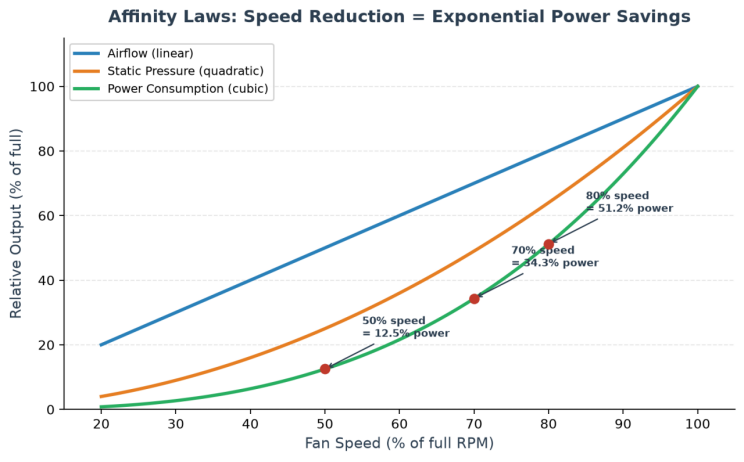
Figure 2: The affinity laws in action. Airflow scales linearly with speed, static pressure scales with the square of speed, and power consumption scales with the cube of speed. Small speed reductions yield large power savings.

The affinity laws are the mathematical foundation of blower fan energy savings. They describe how airflow, pressure, and power change when fan speed changes [3].

The three affinity laws:

Airflow is proportional to speed: 50% speed delivers 50% airflow
Static pressure is proportional to speed squared: 50% speed delivers 25% pressure
Power is proportional to speed cubed: 50% speed consumes only 12.5% power

The cubic relationship between speed and power is the key. Reducing fan speed by just 20% cuts power consumption by nearly half (0.8 cubed = 0.512). At 50% speed, power drops to one-eighth of full-speed consumption. This is why variable-speed EC blower fans deliver such dramatic savings compared to fixed-speed AC blowers with damper control [2].

In practical terms, a blower that draws 500W at full speed consumes only 64W at 50% speed. Even accounting for motor controller losses of 3 to 5%, the net savings are enormous. ASHRAE thermal guidelines for data centers specifically recommend variable-speed fan operation as a best practice, noting that most data center cooling fans operate at 60 to 80% of maximum capacity for the majority of their duty cycle [5].

5. Partial-Load Performance and Control Methods

Blower Fan Energy Savings

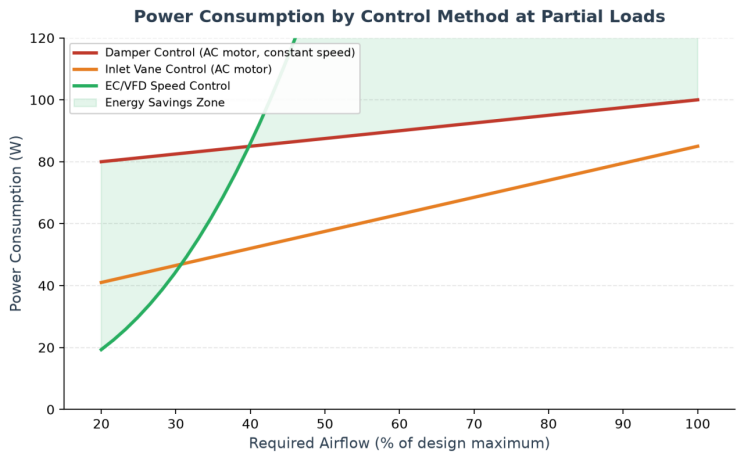
Figure 3: Power consumption by three airflow control methods at partial loads. Damper control wastes the most energy, inlet vane control is intermediate, and EC/VFD speed control delivers the steepest savings as airflow demand decreases.

There are three common ways to modulate blower airflow, and they differ enormously in energy efficiency at partial loads [4].
Damper Control (AC motor, constant speed):

The blower runs at full speed and a mechanical damper throttles the airflow. This is the least efficient method because the motor keeps drawing near-full power regardless of how much air actually moves through the system. At 50% airflow, a damper-controlled blower still consumes 85 to 90% of full-load power [4].

Inlet Vane Control (AC motor, partially throttled):

Inlet vanes pre-swirl the air entering the blower wheel, reducing both airflow and the load on the motor. This is more efficient than damper control but still significantly wasteful. At 50% airflow, an inlet-vane-controlled system typically consumes 55 to 65% of full-load power [4].

EC/VFD Speed Control:

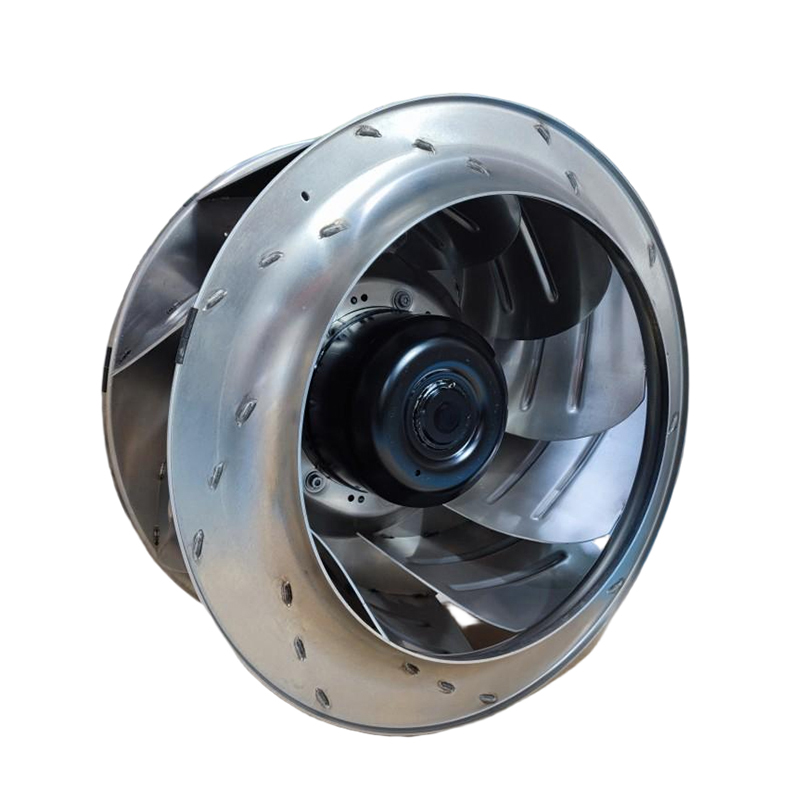
The motor speed itself is reduced via electronic commutation or a variable frequency drive. This is the most efficient method because the affinity laws apply directly. At 50% airflow, an EC blower consumes approximately 12.5% of full-load power, plus a small controller overhead [2]. The difference between damper control and speed control at 50% load can amount to 70 to 80% energy savings.

Sunon has published field data showing that their EC blower modules with integrated PWM speed control achieve measured energy savings of 50 to 65% compared to constant-speed AC equivalents in telecom cabinet cooling applications [7].

6. Real-World Energy Cost Comparisons

Blower Fan Energy Savings

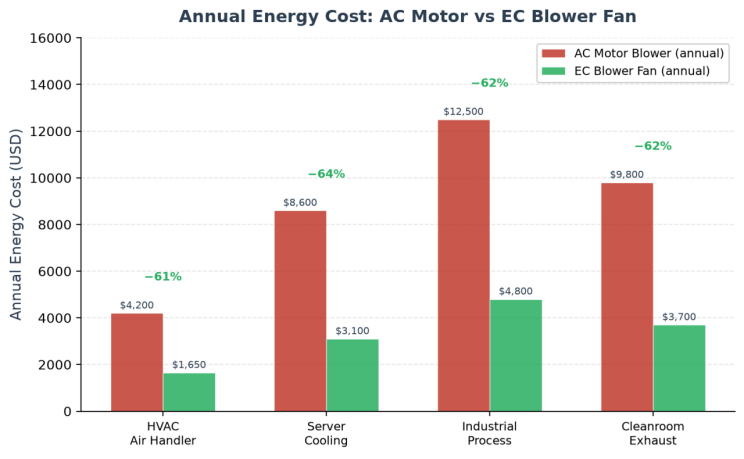
Figure 4: Annual energy cost comparison across four common applications. EC blower fans deliver 55 to 65% lower operating costs than AC motor blowers in every category.
To put the efficiency gains into dollar terms, consider four common blower applications and their typical operating profiles. The cost calculations below assume an electricity rate of $0.12 per kWh and 

continuous operation [6].

In an HVAC air handler running a 1.5 kW AC blower, annual energy cost is approximately $4,200. Replacing it with an EC blower of equivalent airflow capacity reduces annual cost to about $1,650, a saving of $2,550 per year [1]. For a server cooling system running a 3 kW AC blower, the annual cost drops from $8,600 to $3,100, saving $5,500 per year [2].

Industrial process exhaust systems, which often run larger blowers continuously, see even bigger absolute savings. A 5 kW AC blower costing $12,500 per year can be replaced with an EC blower costing $4,800 per year, saving $7,700 annually. Cleanroom exhaust systems show similar patterns, with annual savings of $6,000 or more per blower unit [5].

The U.S. Department of Energy has documented that motor system optimization, including upgrading to efficient motors and implementing variable-speed control, can reduce energy consumption by 20 to 40% across industrial facilities [6]. Blower fans are among the quickest-payback opportunities in this category.

7. Payback Period and ROI Calculation

Blower Fan Energy Savings

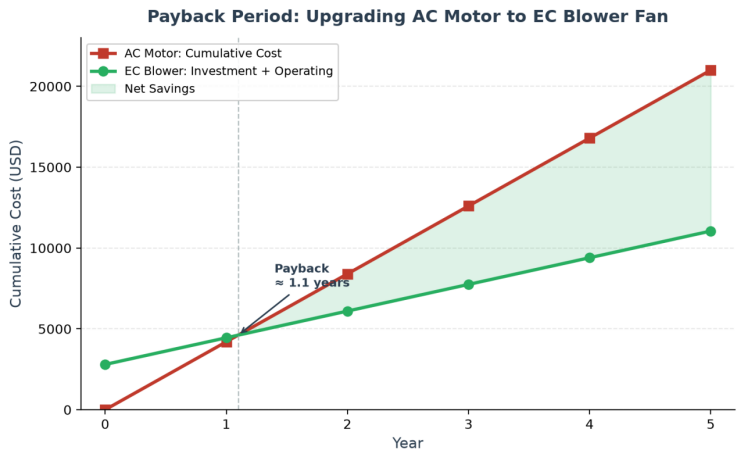
Figure 5: Cumulative cost comparison showing the payback period for upgrading from an AC motor blower to an EC blower fan. The crossover point typically falls between 1 and 2 years, after which the EC blower generates net savings every year.

The upfront cost of an EC blower is typically 40 to 80% higher than a comparable AC motor blower. However, the energy savings pay back that premium quickly. Here is how to calculate the payback period for a typical HVAC air handler upgrade [4].

Example calculation:

AC blower annual energy cost: $4,200 (1.5 kW, 24/7 operation, $0.12/kWh)
EC blower annual energy cost: $1,650 (equivalent airflow, 0.58 kW average)
Annual energy savings: $2,550
EC blower premium cost: $2,800 (installed, including controller)
Simple payback period: $2,800 / $2,550 = 1.1 years
After the payback point, the EC blower generates $2,550 in net savings every year for the remainder of its operating life. With a typical service life of 8 to 12 years for EC blower motors, the lifetime savings can reach $20,000 to $30,000 per unit [1]. Energy Star notes that fan system upgrades are among the few efficiency measures with payback periods under two years that also improve system reliability [8].

For facilities with multiple blowers, the savings multiply. A data center with 20 cooling blowers could save over $100,000 per year by switching to EC blowers with variable-speed control. ASHRAE has documented case studies where data center operators achieved total cooling energy reductions of 40 to 60% after fan system upgrades [5].

8. Application-Specific Savings Opportunities

The savings potential varies by application, but the underlying physics is the same. Here are the most common scenarios where blower fan energy upgrades deliver the fastest returns.
HVAC Air Handlers:

Commercial HVAC systems are the largest single category of blower energy consumption. Retrofitting air handlers with EC blowers and demand-controlled ventilation can reduce fan energy by 40 to 60%. The savings are highest in variable-air-volume (VAV) systems where airflow modulates throughout the day [5].

Data Center Cooling:

Server room and data center cooling fans run continuously, making them prime candidates for EC upgrades. The affinity laws favor speed reduction, and most data centers operate fans at 60 to 80% of capacity. ASHRAE guidelines support variable-speed fan operation as a standard best practice for data center efficiency [5].

Industrial Process Exhaust:

Industrial exhaust systems often run large blowers to remove fumes, dust, or heat. Production schedules create natural partial-load periods where speed reduction saves energy. The DOE has identified motor system upgrades in industrial exhaust as one of the top five efficiency measures by total energy savings potential [6].

Telecom and Electronics Cabinets:

Small DC blower fans in telecom cabinets and electronic enclosures may seem insignificant individually, but deployed in thousands of units across a network, the aggregate savings are substantial. Sunon reports that EC blower modules with PWM control reduce cabinet cooling energy by 50% or more compared to constant-speed fans [7].

Ziehl-Abegg, another major blower manufacturer, has published case studies showing that retrofitting industrial exhaust systems with their EC centrifugal blower modules achieves payback periods of 12 to 18 months in continuous-duty applications [1].

9. Summary

Blower fan energy savings are driven by three factors: the efficiency advantage of EC motors over AC induction motors, the cubic power-speed relationship described by the affinity laws, and the replacement of mechanical throttling with electronic speed control. Together, these factors can reduce blower energy consumption by 40 to 70% depending on the application and duty cycle.
The economics are compelling. With typical payback periods of 1 to 3 years and lifetime savings of $20,000 or more per unit, upgrading to EC blower fans is one of the few efficiency investments that pays for itself quickly and keeps generating returns for years. Whether the application is HVAC, data center cooling, industrial exhaust, or telecom cabinet ventilation, the principles are the same: reduce speed when demand drops, use efficient motors, and eliminate mechanical throttling. The technology is proven, the math is straightforward, and the savings are real.

10. Frequently Asked Questions

Q1: How much energy can I save by switching from an AC blower to an EC blower fan?

Typical savings range from 30 to 70%, depending on your duty cycle and how much time the blower spends at partial load. The biggest savings come in applications where airflow demand varies, because EC blowers can reduce speed and benefit from the cubic affinity law. In constant-speed applications with no throttling, savings are smaller but still significant due to the higher inherent motor efficiency [1].

Q2: What is the typical payback period for an EC blower upgrade?

For most commercial and industrial applications, the simple payback period falls between 1 and 3 years. HVAC air handlers running 24/7 tend to have the shortest payback (under 18 months) because the annual energy cost is high relative to the blower premium. Applications with lower duty cycles will have longer payback periods but still positive returns over the equipment lifetime [4].

Q3: Are EC blower fans more expensive to maintain than AC blowers?

No. EC blower fans generally require less maintenance because they use sealed bearings and have no brushes to wear out. The electronic commutation is solid-state with no moving contacts. Sanyo Denki reports L10 bearing life ratings of 40,000 to 60,000 hours for their EC blower line, comparable to or better than AC equivalents [2]. The integrated speed controller eliminates the need for external VFD hardware and its associated maintenance.

Q4: Can I retrofit an existing AC blower system with EC blowers, or do I need a full replacement?

In many cases, EC blowers are available in the same frame sizes as AC models, allowing a direct swap with minimal mechanical modification. The main considerations are electrical: EC blowers need a DC power supply or AC-to-DC conversion, and the control signal (PWM or 0-10V) must be integrated with your building management system. ebm-papst and other manufacturers offer retrofit kits designed for common air handler platforms [1].

Q5: How do the affinity laws apply to energy savings calculations?

The affinity laws state that power consumption scales with the cube of fan speed. If you reduce speed to 80%, power drops to 51%. At 60% speed, power is only 22% of full-load consumption. This means that even modest speed reductions at partial load yield large energy savings. The DOE has confirmed that affinity-law-based speed control is one of the most cost-effective motor efficiency measures available across all motor-driven systems [6].

11. References

[1] ebm-papst Group. EC Blower Fans: Efficiency Data and Application Guide. Available at: https://www.ebm-papst.com.cn/en/
[2] Sanyo Denki. Sanace Blower Fan Performance and Efficiency Specifications. Available at: https://products.sanyodenki.com/en/sanace/
[3] IEEE. Krishnan, R. (2010). "Permanent Magnet Synchronous and Brushless DC Motor Drives." CRC Press. Available at: https://standards.ieee.org/
[4] AMCA International. AMCA Standard 210 and Energy Efficiency Guidelines for Fan Systems. Available at: https://amca.org/
[5] ASHRAE. Thermal Guidelines for Data Processing Environments and Energy Efficiency Best Practices. Available at: https://www.ashrae.org/
[6] U.S. Department of Energy. Motor Systems Energy Efficiency and Savings Potential. Available at: https://www.energy.gov/eere/amo/motor-systems
[7] Sunon. EC Fan Energy Saving Data and PWM Control Specifications. Available at: https://www.sunon.com/en/
[8] Energy Star. Energy Efficiency Guidelines for Commercial Building HVAC Systems. Available at: https://www.energystar.gov/